
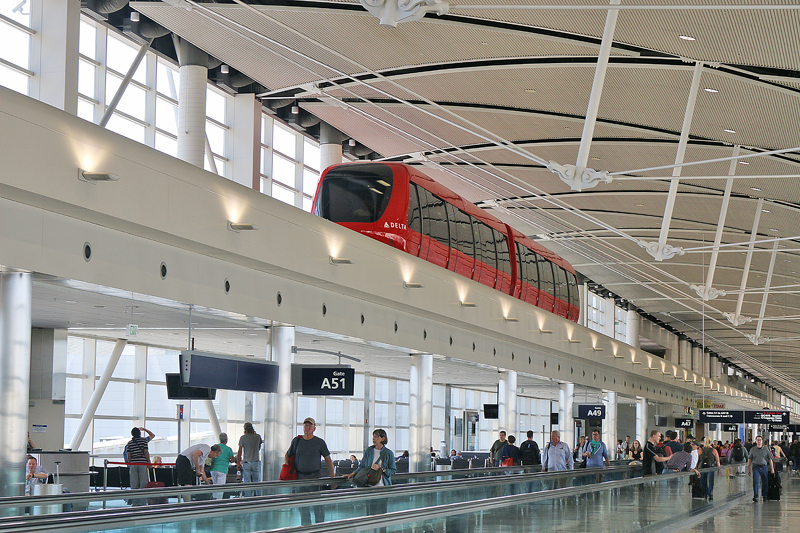

Airports open to public access as of September 2023 — in cooperation with the Transportation Security Administration — have been implemented to allow people to access shops and restaurants that are located in terminals beyond the security checkpoint of the airport without requiring the purchase of an airline ticket and at no cost.
Airports Open to Public Access September 2023
The airports which are currently open to public access include:
- Orlando International Airport — The ExperienceMCO Visitor Pass Program is currently available for people who want to access Terminal C, which recently opened in September of 2023.
- You can apply for this pass up to seven days in advance of your arrival.
- ExperienceMCO Visitor Pass guests must enter the Terminal C security checkpoint general screening line, as entry is restricted to only between the hours of 10:00 in the morning through 4:00 in the afternoon.
- ExperienceMCO Visitor Pass guests are required to exit Terminal C by 8:00 in the evening.
- Capital Region International Airport — The LAN Visitor Pass Program is currently available for people who want access past the security checkpoint at this airport, which serves the greater Lansing area of Michigan.
- LAN Visitor Pass Program is limited to 25 visitors per day and passes are provided on a first come, first served basis (different rules may apply for special events).
- All LAN Visitor Pass holders must complete the security screening process prior to its closure and will not be permitted entry without completing the screening process.
- Visits are restricted to four hours per day, between the hours of 8:00 in the morning through 5:00 in the afternoon; or until the checkpoint closes, whichever is sooner.
- During peak departure times, priority at the TSA Security Screening Checkpoint will be given to ticketed passengers.
- Minors are allowed to participate in the LAN Visitor Pass Program; however, they must be accompanied by an adult.
- Every participating person must complete a separate online registration and receive approval from the airport (including minors).
- Commercial activity is expressly prohibited and will result in removal of the participant and revocation of their privilege to participate in the program.
- If you are applying:
- In advance: Please book your reservation at least 24 hours in advance of your visit. You will receive an e-mail message with your approval status and further instructions prior to your visit.
- For same day entrance: You will receive an e-mail message with your approval status within two hours of submission. LAN also accepts walk-in appointments in the Airport Operations Department. Please note that walk-ins will have up to a 15 minute processing window before using your pass for your information to be available in the system.
- LAN Visitor Passes will only be issued between 8:00 in the morning through and 4:00 in the afternoon, Monday through Friday. Passes will not be issued for admittance on Saturday or Sunday.
- LAN Visitor Passes will only be accepted at the TSA security screening checkpoint until 4 p.m. or until the checkpoint closes, whichever is sooner, Monday-Friday.
- Picking up your pass when you arrive at the airport:
- Park in the short-term parking lot. Parking rates will apply.
- Go to the Airport Operations Department, located on the second floor of the terminal, on the day of your visit to pick up your LAN Visitor Pass. Take the elevators inside the main entrance to the second floor, and the Airport Operations Department will be the last door at the end of the hall on the right.
- Present your identification to the Operations Department personnel to obtain your LAN Visitor Pass.
- Proceed through the security checkpoint on the main floor of the terminal with your identification. Passes are only valid for four hours.
- Tulsa International Airport — The TUL Visitor Pass Program is currently available for people who want access past the security checkpoint effective as of May of 2023 — meaning that the airport became the eighth airport in the United States to allow the public to access shops and restaurants beyond the security checkpoint without requiring an airline ticket.
- You can apply the day of your visit or up to seven days in advance. If you cannot select a date or start time on the online form, that means the visitor slots have reached capacity for that particular day or start time.
- Provide your date of birth, gender, and full legal name exactly as it appears on your identification. You will receive a confirmation e-mail message verifying that your request has been received.
- If you are applying:
- In advance: You will receive an e-mail message with your approval status after midnight on the day of your visit.
- For same day entrance: You will receive an e-mail message with your approval status within 15 minutes.
- If approved for entry, you will receive your TUL Visitor Pass attached to your approval notification e-mail message. When entering the checkpoint, ensure to open the TUL Visitor Pass attachment to provide along with your identification. Ensure to advise the agent of the Transportation Security Administration that you have an TUL Visitor Pass when presenting your identification.
- TUL Visitor Pass participants must enter using the general screening line at the security checkpoint. Entry is restricted from the approved start time through 9:00 in the evening.
- Printed TUL Visitor Passes are accepted.
- At this time, expedited screening and trusted traveler programs, such as the TSA PreCheck and CLEAR programs, cannot be used with the TUL Visitor Pass.
- TUL Visitor Pass availability is limited, granted on a first-come, first-served basis.
- The TUL Visitor Pass is a permanent program. In response to exigent circumstances or operational needs, the Tulsa International Airport reserves the right, in its sole discretion, to cancel the program, cancel approved TUL Visitor Passes, or modify program rules at any time without prior notice.
- Ontario International Airport — The ONT+ Visitor Pass Program was introduced in October of 2022 — meaning that the airport became the seventh airport in the United States to allow the public to access shops and restaurants beyond the security checkpoint without requiring an airline ticket.
- You can apply the day of your visit or up to seven days in advance. If you cannot select a date or start time on the online form, that means the visitor slots have reached capacity for that particular day or start time.
- Provide your date of birth, gender, and full legal name exactly as it appears on your identification. You will receive a confirmation e-mail message verifying that your request has been received.
- If you are applying:
- In advance: You will receive an e-mail message with your approval status after midnight on the day of your visit.
- For same day entrance: You will receive an e-mail message with your approval status within 15 minutes.
- If approved for entry, you will receive your ONT+ Visitor Pass attached to your approval notification e-mail message. When entering the checkpoint, ensure to open the ONT+ Visitor Pass attachment to provide along with your identification. Ensure to advise the agent of the Transportation Security Administration that you have an ONT+ Visitor Pass when presenting your identification.
- ONT+ Visitor Pass participants must enter the approved passenger terminal — either T2 or T4 — using the general screening line at the security checkpoint. Entry is restricted from the approved start time through 9:00 in the evening.
- Printed ONT+ Visitor Passes are not accepted.
- At this time, expedited screening and trusted traveler programs, such as the TSA PreCheck and CLEAR programs, cannot be used with the ONT+ Visitor Pass.
- ONT+ Visitor Pass availability is limited, with differing availability at both passenger terminals — either T2 or T4 — granted on a first-come, first-served basis.
- The ONT+ Visitor Pass is a permanent program. In response to exigent circumstances or operational needs, the Ontario International Airport reserves the right, in its sole discretion, to cancel the program, cancel approved ONT+ Visitor Passes, or modify program rules at any time without prior notice.
- Are you up for having your ONT+ journey filmed? Even better, would you like FREE parking and ONT swag? The airport is looking to document the ONT+ experiences of its guests for social media! If you would like to be featured — and score that free parking and ONT swag — fill out the form here. You will be contacted by telephone or e-mail message if selected.
- Orange County Airport — The OC AirPass program was introduced in 2021 — meaning that the airport became the sixth airport in the United States to allow the public to access shops and restaurants beyond the security checkpoint without requiring an airline ticket.
- Check in at the Information Booth in Terminal A, B, or C — Lower Level, Baggage Claim — from 6:00 in the morning to 7:00 in the evening.
- Applicants are verified through an online security system, usually completed within minutes. Once approved, a pass is completed and printed.
- OC AirPASS is non-transferrable and valid only on the date of issuance. Re-entry on the same day is allowed.
- After check-in, visitors will proceed to a checkpoint on the Departure Level — or upper level — for screening and inspection. OC AirPASS holders will present the pass and identification at the security checkpoint.
- Visitors are limited to one personal item. Hand luggage is not allowed.
- OC AirPass holders must have the pass in their possession while in the secure areas of the terminal.
- An adult with a visitor pass must accompany minors under the age of 18 at all times. If you wish to accompany a traveling minor, you must obtain a gate pass from the airline.
- Visitors must exit the terminal by 11:00 in the evening.
- New Orleans International Airport — The MSY Guest Pass program was introduced in December of 2019 in conjunction with the opening of the new terminal which cost approximately one billion dollars — meaning that the airport became the fifth airport in the United States to allow the public to access shops and restaurants beyond the security checkpoint without requiring an airline ticket.
- The MSY Guest Pass Program is available seven days per week from 11:00 in the morning to 8:00 in the evening daily.
- There will be a limit of 50 visitors Monday through Friday; and a limit of 100 visitors Saturdays and Sundays.
- Anyone 13 years of age or older will need a Guest Pass. All individuals 12 years of age and younger will not need an MSY Guest Pass if accompanied by an adult with an MSY Guest Pass.
- Participants shall be limited to ONE visit per month.
- Participants must provide their full name as it appears on their identification, their date of birth, gender, and contact information.
- Reservations are required at least 24 hours in advance of arrival.
- All participants must be pre-registered and “walk-ups” are not permitted.
- On the day of your reservation, report to the Customer Service Desk on Level 1 of the Main Terminal between Doors 2 and 3.
- Customer Service Staff will inspect your identification and validate that they have pre-registered.
- Participation is contingent upon approval through approved security protocols.
- After check-in, participants will then proceed to the security checkpoint on Level 2 for screening.
- Participants will use the General Boarding Lanes.
- Detroit Metropolitan Airport — The DTW Destination Pass program was introduced on Tuesday, October 22, 2019, which means that the airport became the fourth airport in the United States to allow the public to access shops and restaurants beyond the security checkpoint without requiring an airline ticket.
- The DTW Destination Pass is available for use from 8:00 in the morning until 8:00 in the evening any day of the week at both the McNamara terminal and Evans terminal.
- Visitors younger than 18 years of age must be accompanied by an adult.
- Apply for a DTW Destination Pass the day prior to your visit by clicking on the link at the bottom of this page. You will receive an email stating if you are approved.
- If approved, go to the McNamara Terminal Baggage Claim on the domestic arrivals level, between Carousel #2 and Carousel #3. Look for the “DTW Destination Pass” sign on the back wall.
- Seattle-Tacoma International Airport — The SEA Visitor Pass program was introduced in November of 2018, which means that the airport became the second airport in the United States to allow the public to access shops and restaurants beyond the security checkpoint without requiring an airline ticket.
- You can apply the day of your visit or up to seven days in advance. SEA Visitor Pass is limited to 300 visitors per day. You can see a countdown of the number of passes remaining on the application page. If you cannot select a date on the online form, that means the visitor slots are full for that day.
- Check that your information is accurate and provide your full legal name — exactly as it appears on your passport or driver’s license, date of birth, and your sex. You will receive a confirmation email verifying that your request has been received.
- If you are applying:
- In advance: You will receive an e-mail message with your approval status after midnight on the day of your visit.
- For same day entrance: You will receive an e-mail message with your approval status within 15 minutes.
- If approved for entry, you will receive an e-mail message with a QR code to scan upon entry at checkpoint 3. Ensure you have it on hand — either print or digital — along with your identification when you go for screening; and ensure to tell the agent of the Transportation Security Administration that you have a SEA Visitor Pass. Each person using SEA Visitor Pass must display his or her individual QR code and identification at the security checkpoint. Those without the approval e-mail message will be denied entry. Your application will be reviewed and approved by the Transportation Security Administration.
- SEA Visitor Pass participants must enter through general screening at checkpoint 3 between 5:00 in the morning through 10:00 in the evening.
Rules For All Programs
Note that participants are responsible for all parking fees and expenses. Concession operating times vary.
All participants must present a valid form of identification with a photograph which was officially issued by the government; and that identification must be approved by the Transportation Security Administration.
All participants are subject to the same security screening regulations as passengers boarding an airplane. All items prohibited in carry-on baggage — including liquids, aerosols and gels — apply to everyone who participates in the aforementioned programs for access.
Any of the aforementioned programs can be ended or suspended at any time by the Transportation Security Administration; and all requests and applications for each of the programs must be first reviewed and approved by the Transportation Security Administration.
Employees of the Transportation Security Administration or of the respective airport authorities reserve the right to suspend the program or revoke access beyond the security checkpoint from any individual who may pose a security risk; a risk to any passengers or customers; or violates any of the rules and regulations of any of the airports.
Programs Which Have Been Suspended Indefinitely
Airports which introduced similar programs which have since been suspended include:
- Tampa International Airport — The TPA All Access program is currently suspended as the passenger volumes at the security checkpoints at Tampa International Airport are being evaluated. Tampa International Airport was the third airport in the United States to allow the public to access shops and restaurants beyond the security checkpoint without requiring an airline ticket back on Saturday, May 4, 2019. No timeframe or date has been officially set as to when this program will resume.
- Pittsburgh International Airport — The myPITpass program is currently suspended at Pittsburgh International Airport, which became the first airport in the United States to allow the public to access shops and restaurants beyond the security checkpoint without requiring an airline ticket back on Tuesday, September 5, 2017 — exactly six years ago today. No timeframe or date has been officially set as to when this program will resume.
Final Boarding Call
I have long stated that I believe that a number of security measures which were implemented at airports across the country after the events of Tuesday, September 11, 2001 occurred are superfluous at best and give the arguably false impression that airports are much safer than before that infamous day.

Programs such as the ones that were implemented in Orlando, Santa Ana, New Orleans, Detroit, Tampa, Seattle, and Pittsburgh allow airports to be more accessible. Although I am all for programs of this type — which would allow merchants at businesses within the airport to potentially increase profits while people can spend more time with loved ones at the gate or elsewhere in the secure areas of the airport — problems can possibly occur: on certain days such as holidays, where do people who are not traveling on that day park their vehicles when parking facilities are already full with no empty parking spaces; and will the airports themselves become significantly more crowded?
Regardless, I am glad to learn about more of these programs being introduced for access beyond the security checkpoint without requiring the purchase of an airline ticket — and I hope that it will be considered at additional airports across the United States.
Photograph ©2018 by Brian Cohen.
