
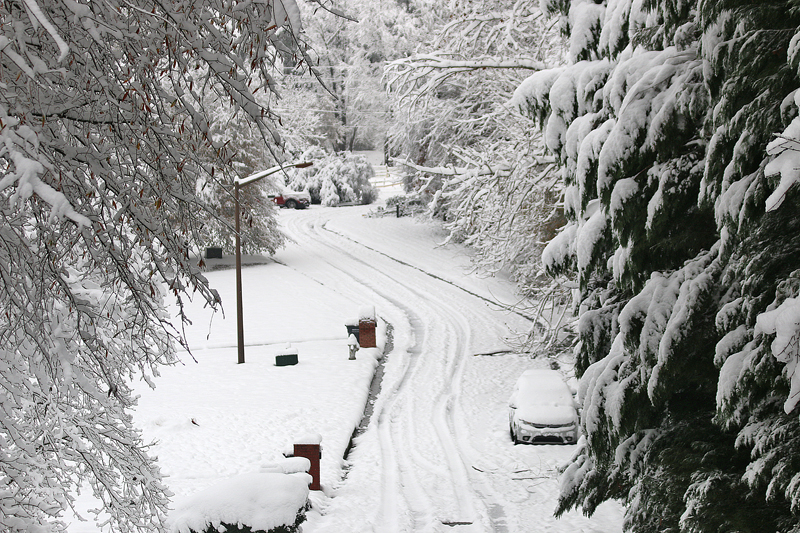

Due to the latest weather system, consider ensuring that you have alternate travel plans ready to be implemented because of a winter storm with record cold and snow to affect the southeastern United States in January of 2026.
Record Cold and Snow to Affect Southeastern United States: January 2026 Travel Alert
The following statement is currently posted at the official Internet web site of the National Weather Service of the United States:
Prolonged Extreme Cold; Eastern U.S. Winter Storm
Another Arctic blast will surge south across the northern Plains tonight, crossing the Midwest and reaching the Gulf Coast Friday night. Dangerously cold temperatures will persist across the eastern U.S. into early February. There is increasing confidence for significant heavy snow across much of the Southern Appalachians, Carolinas, and southern Mid-Atlantic Friday into Sunday.
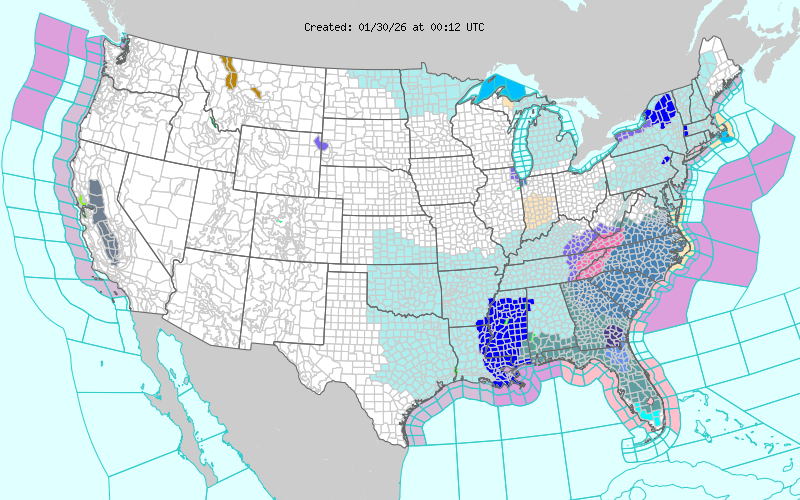
The map of the United States from the National Weather Service currently indicates:
- A cold weather advisory from northern North Dakota and eastern Texas all the way to western Maine
- An extreme cold warning from eastern Louisiana and southeastern Arkansas to extreme northwestern Alabama and northern New York
- An extreme cold watch from southeastern Alabama to eastern Virginia
- A winter storm watch from eastern Georgia to southern Virginia
- A winter storm warning in eastern Tennessee, western North Carolina, western Virginia, and extreme southern West Virginia
- A winter weather advisory in northeastern Tennessee to southern West Virginia
- Cold weather advisories from eastern Montana to northeastern Ohio and from southern New Hampshire to southern Maine
- A freeze warning for southeastern Georgia
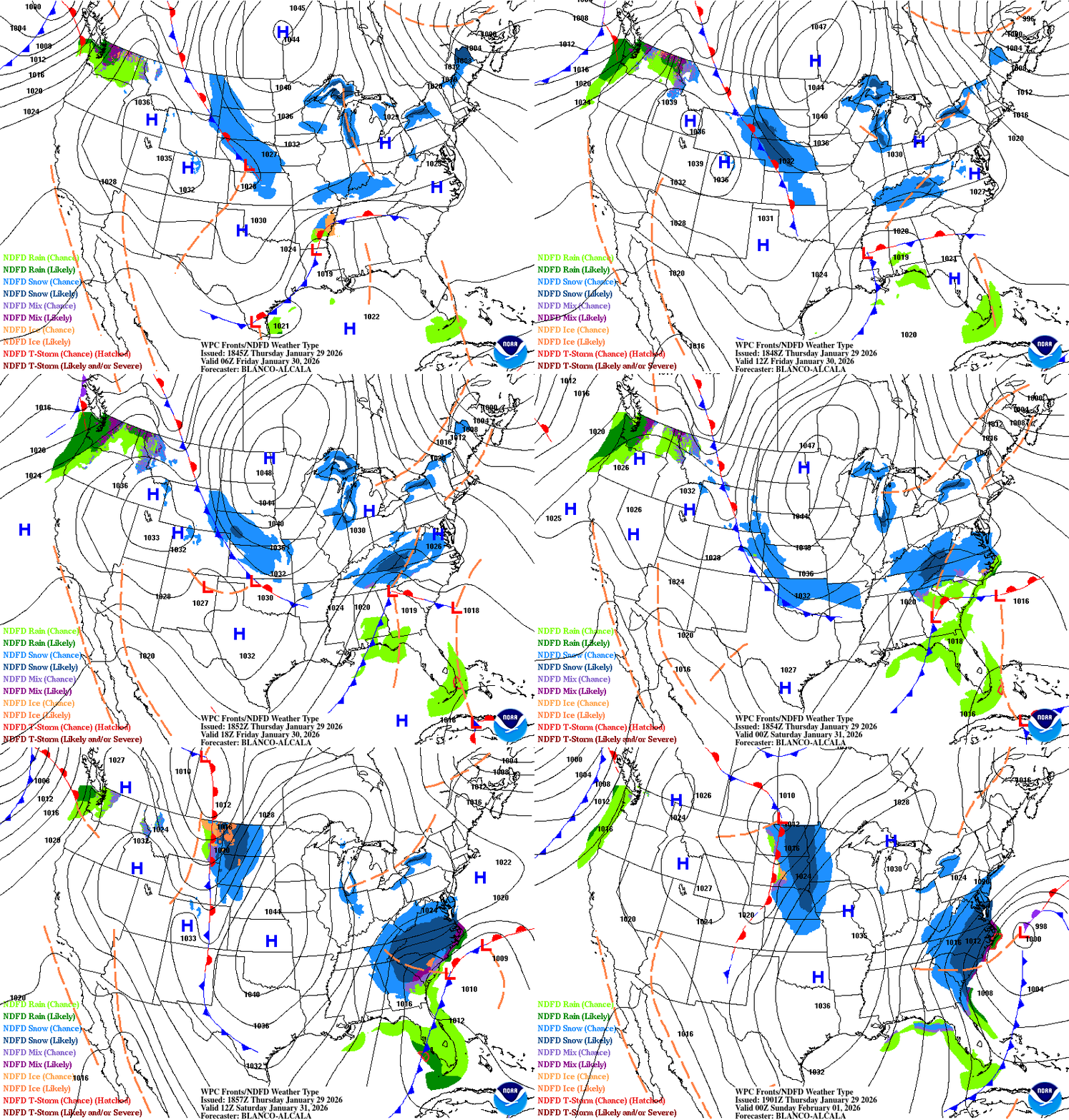
The aforementioned loop shows that snowfall will be likely to occur through Sunday, February 1, 2026 from eastern Montana all the way to Long Island in southern New York and as far south as northeastern Georgia to extreme northeastern Florida. Significant amounts of rain are likely in southwestern Florida.
You read that correctly: snow is possible in parts of Florida because the entire state will see plummeting temperatures from an invasion of frigid air. Miami could see temperatures as low as 36 degrees Fahrenheit Saturday night into Sunday morning; but West Palm Beach and points northward may experience subfreezing temperatures with some of the coldest air in decades, which could break some historic records — such as Tallahassee, whose forecast temperature is 19 degrees Fahrenheit, which would break the current low temperature record of 20 degrees Fahrenheit that was set back in 1977…
…and because the timing of the arrival of moisture in the atmosphere is expected to collide with that frigid air, snow is possible in some areas of Florida.
Even worse is that winds are expected to have areas such as Miami feel like the already cold air is 25 degrees Fahrenheit; and the air in Pensacola could feel as chilly as only five degrees Fahrenheit.
If the timing is right, a strange phenomenon could occur on the west coast of Florida that has been coined as gulf effect snow — which is similar to lake effect snow in the Great Lakes region of the United States; but in this case, warm moisture from the Gulf of Mexico will be carried by the aforementioned winds and cold air over the western coast of Florida, which can result in flurries or snow as far south as Bradenton.
All of this means that citrus crops are potentially in peril from damaging frost, which could lead to shortages of oranges and grapefruits — which would mean higher prices for citrus fruits from Florida.
Meanwhile, the state of North Carolina could experience the heaviest snow in decades — as much as 30 inches could accumulate in local areas from extreme northeastern South Carolina and the eastern half of North Carolina to southeastern Virginia — combined with winds of greater than 35 miles per hour for at least three hours to create blizzard conditions in an area of the United States that is not used to that kind of weather.
Speaking of lake effect snow, significant lake effect snow is expected in the usual areas in western Michigan, northeastern Ohio, northwestern Pennsylvania, and western New York, which includes Buffalo, Rochester, and Syracuse.
At least 828 flights have already been canceled through Saturday, January 31, 2026 at the time this article was written. Expect the cancellation and delay of hundreds more flights to occur over the next couple of days as the weekend progresses.
A state of emergency has already been declared in North Carolina, with more expected to be announced in other states. Expect the shelves of stores to be empty and electric power to be out in numerous areas of the southeastern United States.

Hub airports — such as Atlanta and Charlotte — may be inundated enough with winter weather that could adversely affect their operations and send a ripple effect of delays and possible cancellations throughout much of the rest of the United States.
Flight Waivers, Delays and Cancellations
If you are traveling to, from, or within the southeastern United States over the week or so, expect delays and cancellations of flights. Keep up to date on the latest information pertaining to these winter weather systems which may adversely affect your travel plans. Better yet, postponing or canceling your trip might be a better option — no matter which mode of travel you plan on taking.
If you have a flight scheduled, your flight may be delayed or canceled — and you may be eligible for a waiver of a fee to change your itinerary.
Here are eight airlines which have issued travel alerts as a result of this weather system:
- American Airlines has issued travel alerts for 29 airports in six states for Friday, January 30, 2026 through Monday, February 2, 2026; and Friday, February 6, 2026 is the last day on which tickets must be reissued and rebooked travel must begin.
- Delta Air Lines has issued travel alerts for 22 airports in six states for Saturday, January 31, 2026 through Sunday, February 1, 2026; and Wednesday, February 4, 2026 is the last day on which tickets must be reissued and rebooked travel must begin.
- United Airlines has issued travel alerts for 14 airports in four states for Friday, January 30, 2026 through Sunday, February 1, 2026; and Sunday, February 8, 2026 is the last day on which tickets must be reissued and rebooked travel must begin.
- Southwest Airlines has issued travel alerts for nine airports in four states for Friday, January 30, 2026 through Sunday, February 1, 2026; and Sunday, February 15, 2026 is the last day on which tickets must be reissued and rebooked travel must begin.
- Frontier Airlines has issued travel alerts for Charlotte, Raleigh-Durham, and Norfolk for Friday, January 30, 2026 through Sunday, February 1, 2026.
- Spirit Airlines has issued travel alerts for eight airports in four states for Saturday, January 31, 2026 through Sunday, February 1, 2026; and Wednesday, February 4, 2026 is the last day on which tickets must be reissued and rebooked travel must begin.
- Air Canada has issued travel alerts for both airports which serve Toronto for Thursday, January 29, 2026 through Saturday, January 31, 2026.
- KLM Royal Dutch Airlines has issued travel alerts for 22 airports in six states for Saturday, January 31, 2026 through Sunday, February 1, 2026; and Wednesday, February 4, 2026 is the last day on which tickets must be reissued and rebooked travel must begin.
Final Boarding Call
Do not be surprised to see additional airlines issue travel waivers — as well as existing travel waivers being extended — as this winter weather system progress towards the northeast.
Be sure to contact your airline or transportation provider for the latest information pertaining to your travels — if they are adversely affected — and please: travel safely.
Photograph ©2017 by Brian Cohen.
