
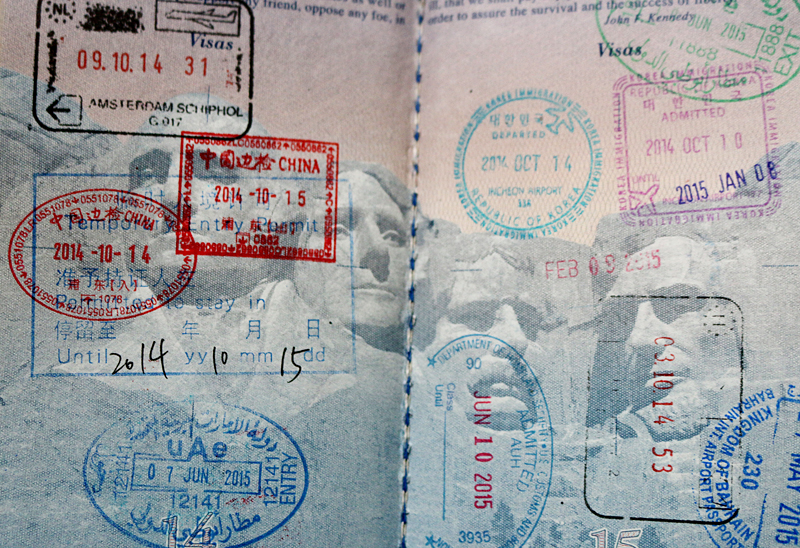

I recently visited Taiwan, Cambodia, Laos, and Vietnam last month during March of 2026. With the exception of Taiwan, all of the countries required fees per person to obtain visas to visit: Cambodia was $30.00; Laos was $45.00; and Vietnam was $25.00 for a grand total of $90.00.
Should Reciprocity Fees — and Visa Fees — Be Reduced or Eliminated?
Those visa fees had me thinking about this article, which was first published on Friday, April 1, 2016 — no fooling — at 5:50 in the afternoon.
I do not necessarily agree with the viewpoint of Jon Nickel-D’Andrea in this article posted at The Winglet, from which this quoted content was extracted: “Contrary to what most people think and feel, it is not a penalty to visitors, nor should it be interpreted that way. At least not when it comes to developing countries. I hate to sound all Sarah McLachlan here, but for the cost of $160 over the course of 10 years you’re helping maintain infrastructure and create hundreds, no thousands of jobs for a developing economy.”
The argument which I have heard from many people is that countries such as Chile, Brazil, and Argentina had imposed reciprocity fees on American citizens primarily because the United States — which is certainly not a developing country — imposed fees on the citizens of those aforementioned countries who visit. That certainly sounds like a penalty to visitors if that is indeed accurate.
Some countries had suffered from economic issues associated with the implementation of visa fees — as well as cumbersome policies — and those countries which rescinded them had reported a mostly positive increase in economic activity directly associated with an increase of visitors to their respective countries.
Of those three countries, Chile and Argentina rescinded their reciprocity fees until further notice; and Brazil temporarily suspended charging fees to visitors in conjunction with the 2016 Summer Olympic games…
…although Brazil reinstated charging for visa to citizens of the United States last year — but the good news is that at least the cost is $80.90 and not $160.00.
Shortly after Belarus relaxed its requirements for visas for visitors, I traveled to that country.
The cost of a visa fee or reciprocity fee is factored at least in part into the decisions of some people — at times, myself included, admittedly — to visit a country; although I do agree that if that were the only reason after spending thousands of dollars on airfare, lodging, ground transportation, meals, souvenirs, and other costs, a couple of hundred dollars might seem to be a paltry reason to have second thoughts about visiting a country.
Citizens of the United States who visit Taiwan are required to complete a digital arrival card within 72 hours of arrival — however, no cost is associated with that.
Why can’t other countries — including the United States — implement such a policy?
Final Boarding Call
I would like to visit Bhutan one day — I understand that Bhutan is an amazing country to visit — but the cost to simply visit that country is $40.00 for the visa and a Sustainable Development Fee of $100.00 per night. Perhaps those fees help prevent that country from being overrun with tourists.

I believe that visitors should spend their money supporting local merchants rather than directly to the governments themselves. By reducing — or, better yet, eliminating — the fees to secure a visa for a visitor, I believe that the economic benefits would more than make up for it. That $160.00 per person for a visa to visit Argentina could instead go towards patronizing businesses and other areas of the general economy, which in turn would increase tax revenues for the government as one of many benefits. I am by no means an expert on economic policies in global economies; but I believe that charging exorbitant visa fees could potentially cause more harm to countries economically in the long term than help them.
Then again, paying to visit a country is arguably similar to visiting the city of New York, which now charges visitors a congestion zone fee simply to enter the lower half of Manhattan — and that program is successful.
Although I can understand why a country would want to impose restrictive visas on visitors for various reasons — keeping track of them while they are in that country for national security purposes; as well as to have a revenue stream — they do stand the chance of losing out on the economic benefits of the dollars of tourists and business people when the process of securing that visa is unnecessarily complicated and prohibitively expensive.
Neither system is perfect, though. What are your thoughts — as well as the reasons behind them? Should reciprocity fees and visa fees be reduced or eliminated — or do they represent the wave of the future?
Photograph ©2016 by Brian Cohen.
