

Every day somewhere on this planet, humans are fighting other humans in physical combat for varying reasons — violations of civil rights; the desire to be heard instead of ignored; revenge for what is perceived as an irreprehensible act — and despite the inherent dangers of visiting such places, there are people who want to voluntarily travel to these areas…
…but if you are a citizen or national of the United States, you will likely soon not be permitted to visit North Korea, as a ban will reportedly be announced by the Department of State in a few days.
Would You Willingly Visit a War Zone?
One compelling reason why a person would willingly visit a war zone could be out of sheer curiosity which could potentially lead to an interesting and memorable experience of a lifetime; but another reason could be because the experience almost certainly guarantees an interesting trip report. As an example of both of those reasons, Daniel Whitfield — who is also known as DanielW on FlyerTalk — posted this trip report pertaining to his visit to northern Syria and Iraq near the front lines against the Islamic State of Iraq and Syria, which is more widely known as ISIS. Complete with plenty of photographs and information, the trip report proved to be wildly popular with fellow members of FlyerTalk, as they used words such as brilliant, intense, incredible and amazing to describe it.
Although Daniel Whitfield hired a personal driver and a guide who also aided in language translation with the people of Syria and Iraq, there are companies which will organize a tour for anyone who wants to visit a war zone. “Beirut, Iraq, Mexico and Africa are all tourism destinations of War Zone Tours”, according to this article written by Glenn of The Military Frequent Flier. “As incredible as it sounds, there are people that really want to go to these places of danger and experience what it is to be like in the middle of a conflict. The founders started this back in 1993 and say they have conducted tours in over 50 countries. They are staffed with High Risk Environment (HRE) guides are all experienced security professionals having spent years traveling dangerous areas of the world. Many are former military special operations personnel.”
Having served in the military for most of his entire career, Glenn offers this cautionary statement: “Apparently, they will customize the tour to your desires. However, I doubt they will give you IBA and an M-4, so you take your chances. And to think I scored two completely free tours of Iraq courtesy of Uncle Sam! Another great military benefit. For those who missed out on deployment, go for it. Just don’t ask POTUS to save you if things go south…”
Dumb, stupid, moronic and idiot were words used by readers who posted in the comments of this article written by Paula Froelich — who used to be the editor in chief at what used to be called Yahoo! Travel — pertaining to travel in Afghanistan, suggesting in the headline of the article that the war is over and tourism to Afghanistan is increasing. Calling it “the country’s best hidden gem”, she also recommended visiting Bamiyan:
Still, Bamiyan, once a critical hub on the Silk Road, is remains medieval. It just got (spotty) electricity last year, thanks to a solar power plant built by the New Zealand government, and sharia law still rules on the outskirts of town. But there is some modernization. Among the donkey carts are cars and people still dressed in the embroidered clothing and salwar kameezes that their ancestors wore but also carrying cellphones.
In the fields lie the ruins of Shahr-e-Gholghola, also called The City of Screams, which was razed to the ground by Genghis Khan, who killed every last man, woman, and child in the city. Hence the name. It has not been touched since it was demolished. And you can almost hear the screams if you climb to the top of the once-fortified stronghold.
I typically lambaste inane articles posted at Yahoo! Travel — The 11 Most Effective Tactics for Getting Upgraded When Flying?!? is only one example — but while I certainly would not outright recommend traveling to Afghanistan, I am not so sure that she deserved the severity of the criticism which she received.
Whether or not Nicosia is considered a war zone per se, the capital city of Cyprus is currently the only city in the world divided with a militarized border. I rented a car when I visited the Republic of Cyprus back in November of 2004 and even crossed the border into Northern Cyprus, which is occupied by Turkey and recognized only by Turkey. Although photography was strictly prohibited and the border was fortified with armed soldiers, I did not feel like I was in any danger — and I had a piece of paper stamped by the border guard in Northern Cyprus to be inserted into my passport instead of stamping directly on a page in the passport itself.
Despite seeing buildings riddled with bullet holes and shelled by heavy artillery to the point where they were complete destroyed, I felt safe when I visited Beirut by myself as an independent traveler in 2006 — and I would not hesitate to return if the opportunity presented itself.
When I visited Seoul back in October of 2014 — and I still have more trip reports to post, including at least one of my visit to the Korean Demilitarized Zone and Joint Security Area — I had actually thought of visiting North Korea; but it was quite expensive and involved a connecting flight in Beijing. The reason why is because it interests me to know of both sides of a conflict, as that is a way to learn differing viewpoints on issues. I definitely heard a few things which I would consider propaganda in South Korea pertaining to North Korea — but whether or not they are true, I will most likely never know for certain.
There are people who would lambaste me for contributing funds to the regime of a known dictator who is accused of alleged repeated human rights violations if I paid to travel to North Korea. Would those people be correct?
“Plenty of more worthy places in the world to receive my tourist dollars” is what Billy Bob — who is a reader of The Gate — posted earlier today in the Comments section of this article pertaining to Americans to be banned from traveling to North Korea. “No plans to visit NK or any other hellhole for that matter.”
Despite being a firm believe in the concept of freedom of travel, “once your travel becomes a liability, that’s a problem for all of us”, JJ — who is also a reader of The Gate — opined. “We shouldn’t be going to North Korea. The rest of the world has a lot to offer. And by the way, South Korea is amazing and very friendly to Americans.”
War zones are not the only places in the world which are considered unsafe. I had no idea that Luxor-al-Hurghada Road in Egypt is one of the most dangerous roads on which to drive in the world — even as I drove on it twice — and there are plenty of other places in the world which are questionable as to whether or not they are safe to visit.
Summary
I have learned over the years that no one is ever completely 100 percent correct on an issue — or, more importantly, that no one is ever completely 100 percent incorrect. Sometimes one has to wade through the chaff to get to the wheat, so to speak. Listening to what someone with an unpopular viewpoint has to say does not necessarily mean that you have to believe that person or sympathize with him or her; but rather learn from it. Obduracy and prejudice between sides can be significant contributing factors towards violence, as the general media reminds us occurs all around the world every day.
In no way would I ever condone the terror attacks which occurred in the United States on Tuesday, September 11, 2001; nor would I accept any excuse to justify those attacks — but unless they are seeking senseless thrills or have something mentally wrong with them, people do not commit heinous acts out of nowhere. Usually, there are mitigating factors which build up over time until they boil over to the point where the person commits a seemingly irrational act. Perhaps they have lived in abject poverty all of their lives and have never been given a chance; or they have been unreasonably oppressed.
In a recent discussion I had with someone, I explained that the terrorists in those attacks most likely endured desperation which I could not even imagine — a desperation so pronounced that the promises of being greeted by virgins in the afterlife and perceived martyrdom can actually seem appealing by comparison. That, of course, does not excuse their acts; but perhaps if people who have legitimate concerns and issues felt like someone was actually listening to them, maybe they would not feel inclined to contribute to a volatile atmosphere — which could possibly lead to a reduction in violence…
…although this article pertaining to a different viewpoint on stopping terrorism argues my points of view.

Unfortunately, political issues have a way of impacting travel at one point or another — and along with religion, politics is one of the main reasons why the differences between people can potentially escalate into fighting, which then creates war zones in hot spots around the world.
As a society, we seem to tend to usually attempt to resolve issues on a reactive basis, rather than a proactive basis. Unfortunately, the behavior and paradigms of human beings in general seem to prevent us from forming a cohesive collaborative team which has the potential to consistently proactively resolve issues before they become problems over which we so vociferously debate that it could lead to violence.
Travel is all about learning and tolerance; and I believe that if more people traveled, experienced different cultures and asked questions genuinely designed to strengthen respect, understanding and tolerance, war zones would be more isolated and — dare I say this — perhaps even obsolete, in my opinion.
Samuel Langhorne Clemens — known by his more famous pseudonym of Mark Twain — said it best:
Travel is fatal to prejudice, bigotry, and narrow-mindedness, and many of our people need it sorely on these accounts. Broad, wholesome, charitable views of men and things cannot be acquired by vegetating in one little corner of the earth all one’s lifetime.
That wishful thinking is part of what keeps me traveling…
…and as to whether or not I would willingly visit a war zone — well…let’s just say that no part of the world is initially out of the question for me; and the answer depends on numerous variables.
A more important question would be to ask if there is any place in the world which is truly 100 percent guaranteed to be safe — and if so, would it be considered too boring to visit?
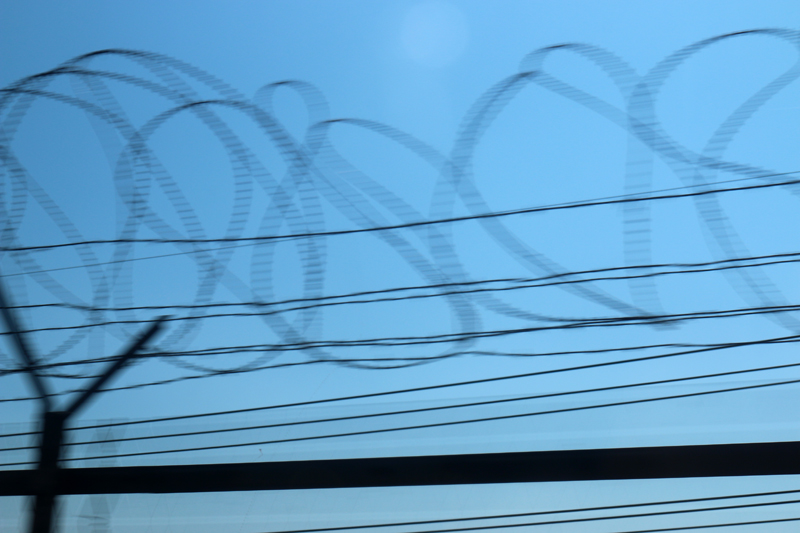
Passing barbed wire at the Korean Demilitarized Zone and Joint Security Area. Photograph ©2014 by Brian Cohen.
